You should usually pick screws for decking because they hold boards flatter, resist pull‑out, and make repairs easier than nails. Screws work best for hardwoods, coastal or wet climates, and whenever you want a long‑lasting, low‑squeak surface; use stainless or coated screws for corrosion resistance. Ring‑ or annular‑shank nails can be faster and cheaper for some softwood builds, but they’ll loosen sooner. Keep going and you’ll get guidance for specific materials, tools, and spacing.
Quick Answer : When to Use Screws or Nails for Decking
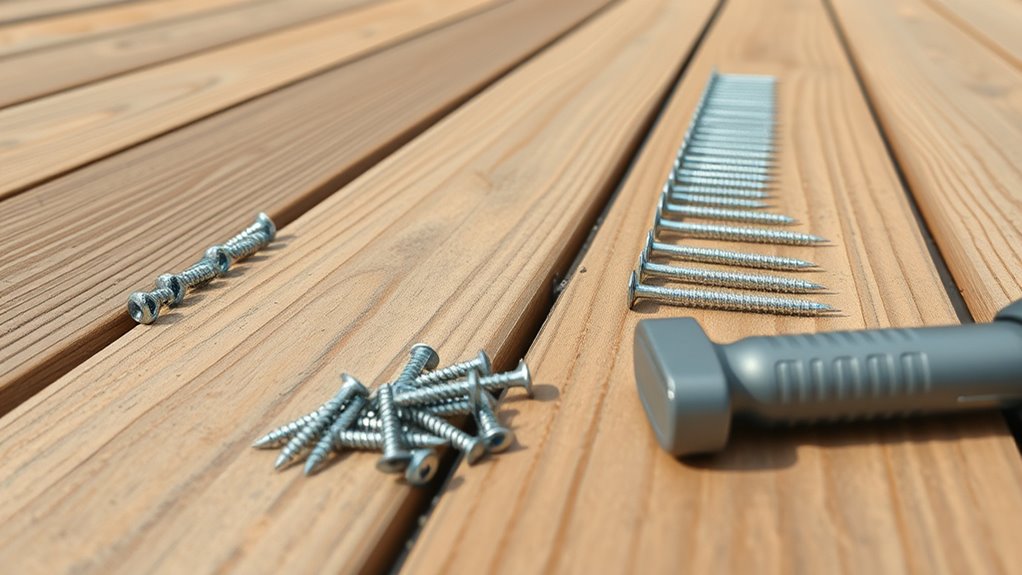
If you want a fast decision: use screws for deck boards and nails for framing and temporary work.
You’ll pick screws when you want strong holding power, easy board replacement, and minimal squeaks.
Choose nails for speed and where slight movement’s acceptable.
Nails are ideal when you need quick fastening and can tolerate a bit of movement.
Account for deck stain and wood treatment—use coated fasteners compatible with the finish and preservative to avoid corrosion and staining.
How to Choose: 3 Criteria for Deck Fasteners
How do you pick the right fastener for your deck? You’ll weigh corrosion resistance, holding power, and fastener ergonomics. Consider nail alternatives like ring-shank nails or hidden fasteners for appearance. Match fastener type to load and weather exposure; prioritize coated or stainless steel for longevity and ease of installation.
| Criterion | Purpose |
|---|---|
| Corrosion | Durability |
| Holding | Structural grip |
| Ergonomics | Installation ease |
Deck Materials and Fastener Choice (Softwood, Hardwood, Composite)
Because different decking materials behave and weather differently, you’ll choose fasteners based on the wood or composite you use.
Softwoods accept nails but benefit from corrosion-resistant coatings.
Hardwoods need higher withdrawal resistance, so screws with deeper screw threads work best.
Composites can split, so use screws sized for synthetic boards.
Avoid cosmetic fixes like nail polish on rust—use proper stainless or coated fasteners instead.
Deck Screws: Types and When to Use Each
Having picked the right fastener type for your decking material, you’ll next choose the specific kind of deck screw that matches both the board and the job. Pick coated screws for corrosion resistance, stainless for coastal hardwoods, and self-drilling for metal framing. Don’t treat screws like nail polish or screws art—use function over flair.
| Type | Best Use |
|---|---|
| Coated | General outdoor |
| Stainless | Coastal/hardwood |
| Self-drilling | Metal framing |
Deck Nails: Ring‑Shank, Annular, Stainless – When to Pick Them
When you want a fast, traditional install that still holds up, pick the right nail type for the job. Use ring‑shank for better grip in softwood, annular for dimensional stability, and stainless for corrosion resistance near water.
You’ll avoid overthinking like treating nails as decorative Nail art; check Fastener patents or specs for coatings and sizes so you choose confidently.
Holding Power: Screws vs Nails (Shear and Withdrawal)
When you compare shear strength, screws usually outperform smooth nails because their threads lock into the wood and resist lateral forces.
For withdrawal resistance, threaded fasteners—especially ring‑ or annular‑shank nails and deck screws—hold far better than smooth nails. But the exact difference depends on wood species and fastener size.
Understanding both shear and withdrawal behavior helps you choose the right fastener for deck joists versus face‑fastening deck boards.
Shear Strength Comparison
Because decks face both downward loads and lateral forces, you need fasteners that resist shear as well as withdrawal.
You’ll find screws typically outperform nails in shear because their threaded shafts and larger diameters resist lateral movement.
Nail polish or fastener adhesives won’t considerably boost raw shear capacity, though adhesives can help composite connections.
Choose fasteners sized and spaced for load, not cosmetic fixes.
Withdrawal Resistance Differences
Shear strength tells you how a fastener handles sideways forces, but withdrawal resistance shows how well it stays put under pull-out loads—something you notice when boards lift or edges warp.
You’ll find screws outperform nails in withdrawal, especially in hardwoods, improving longevity and Fastener aesthetics by reducing movement.
Check Material compatibility and coating to prevent corrosion and guarantee the holding power matches decking species.
Movement & Longevity: Cupping, Squeaks, and Fastener Performance
You’ll notice boards can cup and shift with seasonal moisture changes, and fastener choice affects how much movement you see.
Screws generally hold boards flat longer and reduce squeaks, while nails can loosen over time and let gaps and noise develop.
We’ll compare how each fastener influences cupping, long-term stability, and deck lifespan.
Cupping And Board Movement
Cupping and seasonal movement are the biggest killers of a neat-looking deck, and the fasteners you pick directly affect how boards respond. You’ll notice nail aesthetics can hide quick fixes, but nails let boards shift more freely.
Choose screws for better hold; screw durability limits twist and split, reducing cupping and movement. Proper spacing and fastening pattern control seasonal warping.
Screws Versus Nails Longevity
After addressing how fasteners affect board movement, it helps to look specifically at how screws and nails hold up over time and under load.
You’ll find nails can suffer nail corrosion, loosening and popping, especially in wet climates.
Screws resist withdrawal better, reducing squeaks and movement, but can fail via screw extraction if overloaded or improperly installed.
Choose coated fasteners and proper spacing.
Corrosion & Coatings: Match Fasteners to Outdoor Exposure
Because outdoor conditions vary so much, matching fastener material and coating to the exposure is essential to prevent rust and staining.
You should consider fastener manufacturing quality and finish—stainless, hot‑dip galvanized, or coated screws—to protect structural integrity and deck aesthetics.
Choose coatings rated for marine or coastal environments if needed, and inspect regularly so minor corrosion never undermines fastener performance or appearance.
Working With Pressure‑Treated Lumber: Chemical Compatibility
When you work with pressure‑treated lumber, match fastener metals and coatings to the wood’s chemicals to prevent accelerated corrosion and staining. You should choose hot‑dip galvanized, stainless steel, or proprietary coated screws and nails resistant to copper preservatives.
Don’t mix metals. Avoid decorative finishes that mimic nail polish or nail art on fasteners; they’ll hide corrosion and fail faster.
Inspect and replace compromised fasteners promptly.
Composite & PVC Decking: Recommended Fasteners and Clip Systems
With composite or PVC decking, you’ll often use hidden fasteners to keep the surface clean and prevent surface splitting.
Choose clips made from stainless steel or UV‑stable polymer to avoid corrosion and staining. I’ll explain common hidden fastener types and when each clip material is best.
Hidden Fastener Options
If you want a clean, fastener-free look on composite or PVC decking, hidden fastener systems are the go-to solution—these clips and screws attach to the joists or slide into grooved boards so you don’t see heads on the surface. You’ll appreciate fastener aesthetics and learn hidden fastener types for spacing, drainage, and secure attachment.
| System | Boards | Fixing |
|---|---|---|
| Clip | Grooved | Screw |
| Edge clip | Solid | Screw |
| Rail | Any | Bolt |
Recommended Clip Materials
Because clips sit at the interface between board and joist, you should pick materials that resist corrosion, hold fast under load, and won’t stain or damage composite or PVC.
Choose stainless or coated metals; avoid ferrous parts that bleed.
Use plastics rated UV/stress.
Seal exposed screw threads; avoid contact with nail polish chemicals.
- Stainless steel
- Zinc-alume coated
- Glass-filled nylon
- UV-stable polymer
Hidden Fastening Systems vs Face‑Screwing: Pros and Cons
When you’re deciding between hidden fasteners and face‑screwing, think about appearance, durability, and ease of installation.
Hidden systems improve fastener aesthetics and reduce tripping hazards, but they can be pricier and need precise Fastener installation.
Face‑screwing is quicker, cheaper, and easier to replace boards, yet screws remain visible and can split some decking.
Choose based on budget, look, and maintenance needs.
Fastener Sizes & Spacing by Board Thickness
You’ll want the right fastener diameter for the board thickness—too thin and it won’t hold, too large and you risk splitting.
Spacing should increase with thicker boards and follow manufacturer or code recommendations for load and seasonal movement.
Also keep proper edge and end distances to prevent splitting and guarantee full withdrawal strength.
Fastener Diameter Guide
If you want your deck boards to stay straight and secure, choosing the right fastener diameter matters as much as selecting the correct length and type. You’ll match diameter to board thickness and loading: thicker boards need larger shank for shear strength.
Consider nail techniques and screw types when selecting diameter.
- 1/8″ for thin boards
- 3/16″ standard
- 1/4″ heavy
- pilot for dense woods
Spacing By Board Thickness
Because board thickness affects how much movement and load each fastener must handle, spacing needs to change with the lumber size.
Thicker boards let you increase spacing slightly because they distribute loads better, while thin boards need closer fastener placement.
Use screws with deep screw threads for thinner lumber and consider protective finishes—don’t rely on nail polish for corrosion resistance.
Edge And End Distances
When spacing fasteners, keep clear edge and end distances so boards won’t split or pull out under load. You’ll follow minimums by board thickness:
Maintain Edge spacing from board sides and End distance from board ends to prevent splitting and assure holding power.
- 5/8″ boards: 3/8″ edge, 3/4″ end
- 1″ boards: 1/2″ edge, 1″ end
- 1-1/4″ boards: 5/8″ edge, 1-1/8″ end
- 1-1/2″ boards: 3/4″ edge, 1-1/4″ end
Pre‑Drilling and Pilot Holes: When You Need Them
Although you might skip pre-drilling for thin deck boards or softwoods, you’ll want pilot holes for hardwoods, thicker boards, or near edges to prevent splitting and guarantee fasteners seat flush.
You should match hole diameter to screw shank, not threads, and countersink for a neat finish.
Use nail polish to mark depth.
Consider screws design when choosing bit size and pilot depth.
Installation Tools: Screw Guns, Nailers, and Best Uses
Once you’ve decided on pilot holes and countersinks, pick tools that match your fastener and workflow: screw guns for driven screws, pneumatic or battery nailers for nails, and impact drivers when you need brute torque.
Choose tools that protect fastener aesthetics and speed deck finishing. Consider:
- Screw gun with depth control
- Cordless impact driver
- Pneumatic framing nailer
- Finish nailer for trim
Speed vs. Precision: When Nails Make Sense for Fast Installs
If you need to fast-track decking and can tolerate a bit less holding power than screws offer, nails let you speed through board layout and installation without constantly stopping to set depth or countersink every fastener.
You’ll work faster with a nailer, reduce labor costs, and handle temporary or low-stress decks.
Consider decorative finishes and environmental impact when choosing nail type and corrosion-resistant coatings.
Aesthetics & Finish: Visible Heads, Countersinking, and Plugs
You’ll notice fasteners change the look of your deck — screws leave noticeable heads while nails can sit flatter. Decide how much countersinking you want, since depth affects both appearance and water shedding.
If you want a seamless finish, plan for plugging or concealment methods to hide heads and match the wood.
Visible Fastener Profiles
When building a deck, the look of visible fasteners can make or break the finished appearance, so it’s worth deciding how you want heads, countersinks, and plugs to present.
You’ll consider Fastener aesthetics and Material compatibility, then choose profiles that match style and maintenance.
- Flush heads
- Exposed screws
- Plugged holes
- Decorative caps
Countersinking And Depth
Although countersinking seems like a small detail, it determines whether fastener heads sit flush, catch water, or spoil a board’s clean lines. Getting the depth right keeps the deck looking intentional and helps prevent cupping or rot around exposed heads.
You’ll use proper countersinks, check depth frequently, and avoid overdriving.
For finish touch-ups consider nail polish; choose screwdrivers durability to resist stripping.
Plugging And Concealment
If you want a seamless, professional-looking deck, hiding fastener heads with plugs or careful countersinking makes a big difference.
You’ll choose plugs or flush screws by material and screw gauge, then countersink consistently.
Consider staining or using nail polish to color-match plugs.
- Select correct screw gauge
- Countersink uniformly
- Trim and sand plugs
- Finish and color-match
Repair & Replacement: Removing Damaged Nails vs Screws
Because you’ll eventually need to replace fasteners, knowing how nails and screws come out matters for repair time and the condition of the deck boards.
You’ll pry bent nails, often damaging boards and affecting fastener aesthetics, while screws back out cleanly with a driver, preserving wood.
Screws simplify deck cleaning and targeted replacement; nails may require more board repair and sanding afterward.
Cost Comparison: Fastener Prices, Tools, and Lifetime Value
When you compare nails and screws for decking, consider not just the per-piece price but the tools, labor time, and expected lifespan of the fasteners.
You’ll weigh upfront cost against corrosion resistance, fastener aesthetics, and overall value during deck installation.
- Nails: cheaper per piece
- Screws: costlier, longer life
- Tooling: impact vs driver
- Labor: installation speed vs longevity
Common Installation Mistakes That Cause Fastener Failure
Although fasteners are small, installing them incorrectly can ruin a deck’s strength and appearance. You’ll strip heads, overdrive nails, or misalign boards, compromising fastener aesthetics and structure. Consider hidden fastener options to avoid surface damage. Check spacing, pilot holes, and corrosion-resistant materials.
| Mistake | Fix |
|---|---|
| Stripped heads | Use correct driver |
| No pilot hole | Pre-drill for hardwood |
Regional Climate Effects: Moisture, Freeze‑Thaw, and Salt Air
Where you build your deck changes which fasteners will last: constant moisture speeds rot and loosens unprotected nails.
Salt air accelerates corrosion on ordinary steel. You’ll want corrosion-resistant screws or hot-dipped galvanized/ stainless nails in coastal or wet climates.
Consider materials and fastener coatings matched to your region to prevent premature failure.
Moisture And Rot
Because moisture is the biggest enemy of deck fasteners and boards, you need to match your nails or screws to the local climate.
You’ll prevent rot by choosing coated stainless or hot‑dipped options, and you can touch visible heads with nail polish for fastener aesthetics.
Consider:
- Stainless for wet zones
- Hot‑dipped for longevity
- Coated for appearance
- Proper drainage and spacing
Salt Air Corrosion
If you live near the coast, salt air will aggressively speed up corrosion on both nails and screws, so you should pick fasteners rated for marine environments and plan for more frequent inspections.
Use stainless or hot‑dip galvanized fasteners, check heads regularly, and note screwdrivers compatibility to avoid stripping.
For quick touch‑ups, clear nail polish can slow surface rust until proper replacement.
Building Code & Inspector Preferences for Deck Fasteners
Curious how code and inspectors affect your choice of deck fasteners? You’ll balance fastener aesthetics with structural rules and deck fastening history when selecting corrosion-resistant, approved connectors.
Curious how code and inspectors shape deck fastener choices — balance aesthetics, corrosion resistance, and approved fastening history.
Inspectors want specified materials, install methods, and documentation.
- Use code-listed fasteners
- Prefer corrosion ratings
- Follow approved fastening patterns
- Keep installation records
DIY vs Contractor Choices: What Pros Use and Why
Now that you know how codes and inspectors shape fastener choices, think about how that plays out in real-world builds: DIYers often pick simpler, more forgiving options like coated screws for ease and appearance, while contractors usually reach for code-listed structural screws or hot-dipped galvanized/ stainless lag screws and bolts that meet load specs and speed installation. You’ll weigh Nail discoloration and Screw head visibility.
| User | DIY | Pro |
|---|---|---|
| Cost | Lower | Higher |
| Appearance | Better | Functional |
| Corrosion | Varies | Specified |
Decision Checklist: 10 Questions to Pick Nails or Screws
Want a quick way to decide between nails and screws for your deck? Use this checklist to evaluate performance and appearance, including Fastener aesthetics and Deck color coordination.
- Will holding strength matter long-term?
- Is split resistance critical for your boards?
- Do you prioritize Fastener aesthetics?
- How important is Deck color coordination?
Answer these to pick the right fastener.
Quick Recommendations: Best Fasteners for 8 Common Deck Scenarios
When you’re deciding fasteners for common decking situations, these quick recommendations cut through the noise so you can pick what’s proven to work.
For pressure-treated pine, use coated screws for fastener durability.
For hardwoods, pick stainless steel screws.
For hidden connections, use clips or ring-shank nails.
For floating or wide boards, allow for wood expansion and use slotted fasteners.
For railings, choose structural screws.
Frequently Asked Questions
Can I Use the Same Fasteners for Deck Railing and Joist Framing?
Yes — but you shouldn’t always. You’ll match fastener types to load: use structural screws or bolts for joist framing, and corrosion-resistant screws or nails for railing. Prioritize material compatibility to prevent failure or corrosion.
How Do Fasteners Affect Deck Warranty From Manufacturers?
Your deck warranty can be voided if you use improper fasteners; you’ll need fastener durability and weather resistance that match manufacturer specs, so always follow their approved fastener lists and installation guidelines to keep coverage.
Are Stainless Screws Magnetic-Safe for Use Near Solar Panels?
Sure — stainless screws are generally magnetic-safe for use near solar panels. Silent, subtle stainless steel won’t worsen magnetic interference, so you’ll maintain solar panel compatibility, but check specific panel specs and use non-magnetic grades if concerned.
Can Electrolytic Corrosion Occur Between Fasteners and Metal Flashing?
Yes — you can get electrolytic (galvanic) corrosion between fasteners and metal flashing if metal compatibility’s poor; you should match metals or use barriers or coatings to prevent current flow and sacrificial corrosion of the less noble metal.
What Fasteners Are Best for Floating or Modular Deck Systems?
About 75% of modular decks use corrosion-resistant fasteners, so you’ll choose stainless or coated screws for floating or modular systems. Prioritize deck material compatibility and precise fastener installation techniques to prevent movement and electrochemical issues.
Conclusion
Like choosing the right key for a lock, your fastener choice open a long‑lived deck. You’ll want screws when you need strong, lasting grip and easy fixes, and nails when speed and shear toughness matter for hidden or temporary parts. Match fastener type to your decking material, local code, and whether you’re DIYing or hiring pros. Answer the 10 checklist questions, then pick the fastener that balances corrosion resistance, holding power, and installation needs.