Can Self Tapping Screws Go Through Steel? Thickness Limits Explained
Yes — you can drive self-tapping screws into steel, but success depends on screw type, steel thickness, and prep. For common mild sheet steel you’ll usually get away without predrilling up to roughly 3–5 mm (1/8″–3/16″); beyond that or with hardened alloy you’ll need pilot holes or self-drilling (Tek) screws to avoid stripping or breakage. Match screw material and coating to prevent corrosion and test on scrap; keep going below for practical limits and selection tips.
Short Answer: Can Self-Tapping Screws Go Through Steel?
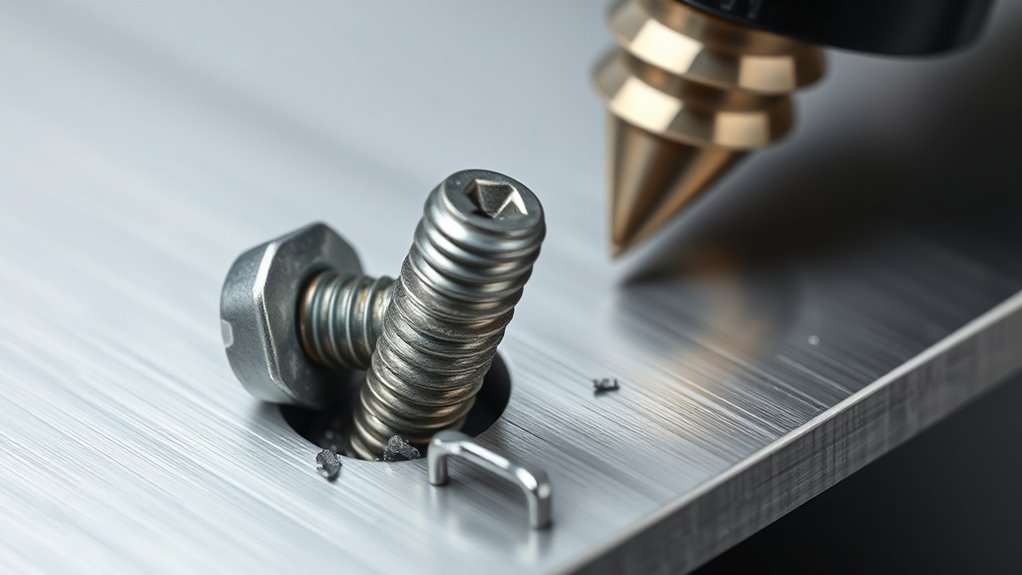
If you need a quick answer: yes — self-tapping screws can go through steel, but their effectiveness depends on the screw type, steel thickness, and whether you predrill.
You’ll choose screw geometry and coating for paint compatibility and corrosion resistance.
For thin sheet steel you often don’t predrill; thicker plate or hardened steel needs predrilling or specialized tapping screws to guarantee secure threads.
How Do Self-Tapping Screws Cut Threads in Metal?
How exactly do self-tapping screws form threads in metal? You drill a pilot hole or use an established hole, then the screw’s cutting edges displace metal to create mating threads.
How do self-tapping screws cut threads? Start with a pilot hole and let the screw’s cutting edges displace metal.
Keep surface preparation simple to remove debris and boost corrosion resistance.
Steps:
- Align and start slowly.
- Apply steady torque.
- Clear chips and inspect fit.
Self-Tapping vs Self-Drilling (Tek) Screws: Key Differences
While both screw types save you time and labor, self-tapping and self-drilling (Tek) screws work differently.
Self-tapping screws need a pre-drilled hole and cut threads as you drive.
In contrast, self-drilling screws have a built-in drill point that bores and taps in one pass.
You’ll choose between them based on material thickness, access, and speed.
Both come in various color options and aesthetic finishes to match exposed work.
Self-Tapping Screw Types and Uses
Because self-tapping screws come in several head styles, thread forms, and tip designs, you’ll pick the one that matches the material and load requirements rather than using a one-size-fits-all fastener.
Because self-tapping screws vary in head, thread, and tip, choose the style that suits your material and load.
You’ll consider Color options and packaging sizes when specifying screws.
Choose by application:
- Sheet-metal: coarse thread, pan or hex washer head.
- Machine: fine thread, countersunk head.
- Specialty: self-drilling or thread-forming tips.
Self-Tapping Screw Materials (Steel, Stainless, Hardened) : Pros/Cons
Picking the right head, thread, and tip only gets you part of the way; the screw’s base material determines strength, corrosion resistance, and whether the fastener will damage the mating part.
You’ll choose steel for cost and hardness, stainless for superior corrosion resistance with varied surface finish options, or hardened for wear.
Each trades ductility, galvanic risk, and machinability—match material to application.
Steel Grades and Hardness That Affect Screw Penetration
When you push a self-tapping screw into steel, the alloy grade and its hardness dictate whether the fastener will cut clean threads, blunt, or fracture—so matching screw material and geometry to the substrate is critical.
You should consider:
- Mild steel: softer, easier penetration; watch plating and surface treatments.
- HSLA/quenched: higher hardness needs harder screws.
- Stainless: work-hardens; balance corrosion resistance and screw hardness.
Thread Form and Point Geometry That Matter for Steel
Hardness and alloy choice set the stage, but the screw’s thread form and point geometry determine how it actually engages and cuts into steel.
You’ll pick a sharp, tapered point geometry for piercing and a reinforced blunt point for forming.
Thread design—pitch, depth, and profile—controls cutting vs. cold-forming.
Match design to steel hardness to reduce torque, burrs, and work hardening.
How Screw Diameter Affects Steel Penetration
When you choose a screw diameter, you’re also deciding the right pilot size and how well the threads will bite into the steel.
Larger diameters usually need larger pilots and deeper threads to distribute load and prevent stripping.
You’ll also want to match drill point geometry to diameter so the tip cuts efficiently without causing material split or excessive torque.
Screw Diameter vs. Pilot
Although a larger self-tapping screw gives you more thread engagement, the screw’s outer diameter also changes how the pilot hole needs to be sized and how easily the screw can cut into steel.
You should consider surface treatments and corrosion resistance when selecting diameter.
- Match pilot to core diameter.
- Increase pilot for thick steel.
- Reduce for soft metal.
Thread Depth Influence
Pilot size and screw diameter set the stage, but thread depth determines how aggressively a self-tapping screw bites into steel.
Deeper threads remove more material and create stronger mechanical engagement, while shallow threads rely more on surface contact and can strip under load.
You’ll choose depth to maximize thread engagement and guarantee material compatibility, balancing holding power against insertion torque and damage risk.
Drill Point Geometry
How does screw diameter change the way a drill point slices into steel? You’ll see larger diameters concentrate force, letting the drill point bite cleaner, while smaller diameters need sharper geometry.
Consider these factors:
- Diameter vs pressure: bigger = more shear, less deflection.
- Drill point angle: affects entry and heat.
- Thread design: influences chip evacuation and holding in steel.
Screw Length vs Metal Thickness: Matching Length to Job
When you’re picking a self-tapping screw, matching its length to the metal thickness is critical: too short and it won’t hold, too long and it can snag, protrude, or stress the material.
Choose a screw that penetrates enough to engage threads without excessive exit.
Consider surface corrosion and environmental factors when selecting coatings and extra length to allow future wear or protective layers.
Pre-Drilling Rules by Steel Thickness
After you’ve matched screw length to the metal thickness, decide whether to pre-drill based on that thickness and the screw type. You’ll weigh corrosion risk, environmental impact, and aesthetic considerations.
Consider:
- Thin steel: usually no pilot, avoid distortion.
- Medium: small pilot to reduce stress.
- Thick: larger pilot, guarantee full thread engagement and neat finish.
Typical Limits: Thin-Gauge Steel (Up to 1.2 Mm)
Because thin-gauge steel up to about 1.2 mm bends and cold-works easily, you’ll typically use self-tapping screws without a pilot hole for light fastening—provided you pick a screw with shallow threads and a sharp point to minimize distortion and pull-through. Choose coatings for corrosion resistance and check fastener compatibility with thin sheets.
| Thickness | Screw type | Coating |
|---|---|---|
| 0.6 mm | Fine thread | Zinc |
| 1.0 mm | Self-tap | PTFE |
Typical Limits: Light Structural Steel (1.2–3 Mm)
If you’re fastening into light structural steel between about 1.2 and 3 mm, you’ll usually pre-drill or use self-drilling screws designed for higher shear and thread engagement to avoid excessive work-hardening or distortion.
You should consider:
- Screw grade and tip geometry for clean penetration.
- Surface treatments to prevent corrosion and aid threading.
- Environmental factors like temperature and moisture that affect installation torque.
Typical Limits: Heavy Sheet and Plate (3–6 Mm)
When you work with heavy sheet and plate (3–6 mm), you’ll hit drilling capacity limits that can require pre-drilling or higher-torque drivers.
Check that the screw material and coating are compatible with thicker steel to avoid galling or corrosion over time.
You’ll often need harder alloys or stainless options and adjusted pilot sizes to guarantee reliable threads.
Drilling Capacity Limits
How much material can a self-tapping screw reliably penetrate in heavy sheet and plate (3–6 mm)? You’ll find drilling capacity limits depend on pilot hole, screw geometry, and tool torque.
Consider corrosion prevention and ease of fastener removal when selecting depth.
- Pilot hole size impacts thread engagement.
- Screw length must exceed thickness by set margin.
- Torque limits dictate max penetration.
Screw Material Compatibility
Which screw material fits your 3–6 mm steel job depends on galvanic compatibility, strength, and corrosion resistance—and you’ll want to pick to minimize corrosion and maintain joint integrity.
Choose stainless or zinc-plated carbon steel for heavy sheet and plate.
Consider sacrificial coatings or ceramic fastener coatings where dissimilar metals meet.
Prioritize corrosion prevention, matching hardness to avoid galling, and verifying torque specs.
Why Self-Tapping Screws Strip Threads
Because self-tapping screws cut their own threads rather than relying on a pre-formed helix, they can strip the mating threads if the screw, material, or installation technique isn’t matched correctly.
You avoid stripping by addressing key factors:
- Wrong hardness or poor coating corrosion resistance.
- Incorrect pilot hole or thread engagement.
- Bad torque calibration or overtightening during driving.
Causes of Screw Breakage When Driving Into Steel
Stripped threads are one failure mode, but screws can also snap under load or during installation when conditions aren’t right. You risk breakage from excess torque, hardened steel contact, or fatigue from vibration.
Poor corrosion resistance weakens shafts over time, and compromised threads from rough handling reduce clamping strength.
Choose proper grade, avoid overdriving, and preserve the aesthetic finish to prevent premature failures.
How Pilot Holes Improve Performance in Steel
When you drill the correct pilot hole size for the sheet thickness, the screw will feed smoothly and you’ll cut down on driving torque.
That proper hole also reduces the chance of thread stripping by letting the threads form cleanly without excess material binding.
Start with the manufacturer’s recommended size and adjust for harder steels to prevent failures.
Drilling Correct Pilot Size
How do you pick the right pilot size for self-tapping screws in steel? You want clean entry, correct engagement, and preserved finish—especially where color contrast or aesthetic appeal matters.
- Match drill to screw root diameter for proper thread bite.
- Reduce insertion torque by 70–90% with slightly larger pilots in thicker steel.
- Test on scrap to confirm fit and surface integrity.
Reducing Thread Stripping
After choosing the right pilot size, you’ll want to prevent thread stripping by letting the hole control how the screw engages the steel.
Drill clean, match pilot diameter to core screw size, and use thread lubrication to reduce torque and wear.
Apply coatings or select plated screws for corrosion resistance so threads stay strong over time, minimizing re-taps and failure during installation.
Pilot Hole Sizes for Self-Tapping Screws (By Diameter & Material)
Because pilot holes control thread engagement and prevent material splitting, you’ll want the right size for each screw diameter and base material. Match drill to core diameter, account for surface coatings and environmental corrosion when choosing clearance, and test on scrap.
Recommended starting points:
- Thin steel: pilot ≈ 70–80% core diameter.
- Thick steel: pilot ≈ 85–95% core diameter.
- Soft metals/plastics: pilot ≈ 60–70% core diameter.
When to Choose Self-Drilling (Tek) Screws Instead
If you’re working with thicker or multiple layers of steel where drilling a pilot would be time-consuming or unreliable, self-drilling (TEK) screws are often the better choice.
You’ll save time and reduce tool changes when fastening roofing or framing.
Choose TEK screws with compatible surface finish and corrosion resistance for exterior use, and match drill capacity to total gauge thickness for reliable threads and holding power.
Coatings and Lubricants That Help Self-Tapping Screws Cut Steel
When you’re driving self-tapping screws into steel, the right coatings and lubricants cut friction, reduce heat, and extend both screw and bit life. You’ll want to balance coating durability with sharp edge retention and consider lubricant effects on torque and chip evacuation.
- Dry coatings for corrosion resistance.
- Zinc/galvanic layers for wear.
- Cutting oils to lower torque and clear swarf.
Screw vs Base Metal Combinations to Avoid
While some screw and base-metal pairings seem fine at first glance, you should avoid combinations that promote galvanic corrosion, excessive galling, or metal contamination.
Don’t pair dissimilar metals without appropriate surface coatings or sacrificial barriers.
Consider environmental factors like humidity, salt exposure, and temperature cycles.
Favor matched materials or insulating layers to prevent accelerated corrosion, seizing, and compromised joint integrity.
Driver Types, Torque Settings, and Clutch Tips for Steel Work
You’ll want the right driver type, proper torque settings, and clutch adjustments for reliable self-tapping into steel.
Match driver bits and drive speeds to screw size and steel thickness.
Use moderate torque to avoid stripping or breakage, and lower the clutch for final seating.
Test on scrap steel to fine-tune settings before you start the job.
Driver Types Overview
Because driving self-tapping screws into steel demands both power and control, choosing the right driver type and settings matters more than you might think.
You’ll pick drivers considering surface treatments and corrosion resistance to avoid galling.
Recommended options:
- Corded drill/driver for consistent power.
- Impact driver for high torque bursts.
- Screwgun with clutch for precise engagement.
Torque Setting Guidelines
Selecting the right driver was only part of the job; now you need to match torque and clutch settings to the steel you’re working with.
Set lower torque for thin gauge to prevent punch-through and warping; increase for thicker sections.
Use adjustable clutches to avoid stripping.
Control speed to protect paint adhesion and preserve aesthetic finish, and test on scrap before final assembly.
Clutch Adjustment Tips
When you adjust the clutch on your driver, match the setting to the steel thickness and driver type so you can avoid overdriving or stripping fasteners. Use clutch adjustment and gear shifting awareness to protect threads and bits.
Follow these quick tips:
- Start low for thin gauge steel.
- Increase gradually for thicker sections.
- Use impact driver for stubborn holes.
Power Tools vs Hand Drivers: Pros, Cons, and Best Practice
Whether you’re tightening a few screws or working through a full sheet of steel, choosing between power tools and hand drivers affects speed, control, and the finish of your work. You’ll balance speed with control, consider color matching and other aesthetic considerations, and choose tools to minimize damage.
| Tool | Benefit |
|---|---|
| Drill | Fast |
| Driver | Controlled |
| Hand Driver | Precise |
| Impact | Powerful |
Driving Technique: Speed, Pressure, and Feed for Steel
Although steel demands more care than softer materials, you can control screw seating and avoid workhardening by matching speed, pressure, and feed to the screw size and steel thickness.
Adjust technique to protect surface treatment and limit fastener corrosion:
- Start slow to align threads, increase feed steadily.
- Moderate pressure prevents cam-out and metal deformation.
- Reduce speed as thickness or hardness rises.
Heat Effects While Driving and How to Minimize Them
Because driving screws into steel generates friction and deformation, you’ll often see heat build-up at the contact points that can alter temper, soften the metal locally, and damage coatings.
So control of speed, pressure, and tooling is key to minimizing thermal effects.
You should reduce dwell, use sharp bits, apply lubricant, and allow cooling pauses to limit heat distortion and thermal expansion, preserving material properties and fit.
Corrosion and Galvanic Tips for Steel Fastened Joints
When you join different metals with self-tapping screws, galvanic corrosion can attack the less noble material at the contact point.
Choose compatible fastener materials and durable protective coatings—like zinc, hot-dip galvanizing, or appropriate paint systems—to interrupt the electrochemical cell.
Also consider barriers (washers, sealants) and matching metals to minimize corrosion risk.
Galvanic Corrosion Basics
If you fasten dissimilar metals together in the presence of an electrolyte, galvanic corrosion will try to undermine the joint by making the less noble metal corrode faster.
You should recognize risks and act:
- Identify metals’ relative nobility.
- Isolate contacts or use protective coatings where possible.
- Control electrolytes and drainage to minimize cell formation and prolong joint life.
Protective Coating Options
Although coatings won’t eliminate galvanic risk entirely, they give you powerful tools to slow corrosion and electrically isolate dissimilar metals at fastened joints.
Choose protective coatings like zinc plating, epoxy, or hot-dip galvanizing to boost corrosion resistance.
Apply thin dielectric layers or sealants at contact points, maintain coating integrity during installation, and inspect regularly so you’ll limit electrolyte pathways and extend joint life.
Fastener Material Compatibility
Why choose one fastener material over another? You’ll balance corrosion resistance, decorative finishes, and environmental impact to avoid galvanic issues.
Consider:
- Match metals where possible to minimize corrosion.
- Use isolators or coatings if dissimilar metals are necessary.
- Choose stainless, coated carbon, or sacrificial zinc depending on exposure and appearance.
You’ll extend joint life and maintain aesthetics by selecting compatible fasteners.
Strength: Tapped Hole vs Nut-and-Bolt
When you compare strength between a tapped hole and a nut-and-bolt, consider how load path, thread engagement, and material thickness interact.
When comparing tapped holes and nut-and-bolt joints, consider load path, thread engagement, and material thickness.
You’ll find tapped holes save space but rely on steel thickness and thread quality.
Nut-and-bolt assemblies offer greater clamp force and redundancy.
Account for corrosion resistance and fastener compatibility when choosing: coatings, galvanic pairs, and washer use change long-term performance.
How to Test a Screw’s Pullout Strength in Steel
Before you test pullout strength, set clear variables: specify screw type and size, steel grade and thickness, hole condition (tapped or self-tapping), and the failure mode you’ll measure (thread stripping, screw fracture, or base-metal pullout).
Then you’ll:
- Mount specimen, control alignment and clamping.
- Apply axial pull at constant rate, record peak load.
- Inspect failure, note effects of surface coatings and corrosion resistance.
Inspection Checklist After Driving Screws Into Steel
After driving self-tapping screws into steel, you should check the hole edges for burrs or sharp metal fragments that could weaken the joint or cause injury.
Inspect each fastener to verify it’s fully seated and flush with the surface, not over- or under-driven.
Address any burrs and reseat or replace screws as needed before finishing.
Check For Burrs
Although the screw’s head may sit flush, you still need to inspect the hole edges for burrs that can cut skin, foul threads, or interfere with sealing. You should perform burr removal and surface preparation promptly.
Check these items:
- Visual: look for sharp edges or metal shards.
- Feel: run a gloved finger for snags.
- Clean: remove debris and prep for coating or sealant.
Verify Fastener Seating
Want to make sure your screw did its job? Inspect seating: the head should sit flush without gaps, distortion, or crown marks. Verify torque and alignment.
Confirm threads engaged full depth, and check opposing side for proper chip formation from drilling techniques.
Note any looseness or signs of fastener corrosion; replace compromised screws and retest to guarantee secure, leak-free joints.
Common Scenarios and Recommended Fastener Choices
When you’re fastening into thin sheet steel, into thicker structural members, or through coated surfaces, the right self-tapping screw choice changes.
Use sharp-threaded, thin-sheet screws for light-gauge panels.
For light-gauge panels, choose sharp-threaded screws designed to bite easily into thin sheet metal.
For thicker or load-bearing connections, use coarse-thread and higher-tensile fasteners.
For painted or galvanized materials, consider corrosion-resistant or sealed-head designs.
- Thin gauge: fine/threaded, point styles.
- Thick steel: coarse, high-tensile.
- Coated surfaces: consider Surface coatings, Environmental factors, and sealing.
Repairing Stripped or Damaged Threads in Steel
If you strip or damage threads in steel, you can usually restore the fastening function without replacing the whole part by choosing the right repair—whether re-tapping, using a helicoil, oversized bolt, or thread repair insert—and preparing the hole properly to guarantee fit, strength, and corrosion resistance.
You should clean, deburr, and apply corrosion prevention.
Choose inserts for load, and finish for fastener aesthetics to match the part.
Alternatives for Thick or Hardened Steel (Rivets, Welds, Bolts)
Because self-tapping screws can struggle with very thick or hardened steel, you’ll often use other fasteners or permanent joins—rivets, welds, or through-bolts—to get reliable strength and alignment.
Choose based on access, vibration, and finish. Consider surface coatings and paint adhesion when joining.
- Solid rivets for permanent shear strength
- Welds for continuous seals and load transfer
- Through-bolts for disassembly and clamp load
Cost and Availability: Practical Fastener Choices
Choosing between rivets, welds, bolts, or self-tapping screws often comes down to cost and availability as much as suitability for the metal—so you’ll want to factor prices, local stock, and installation time into your selection.
You should weigh upfront cost, tool rental, and lead times, plus paint compatibility and environmental considerations, choosing the fastest, cheapest reliable option that meets corrosion and finish requirements.
Safety Tips When Fastening Into Steel
When you fasten into steel, take steps to protect yourself and your work: wear eye and hearing protection, use gloves that still let you feel tools, and clamp pieces to prevent movement. Follow these quick tips to stay safe and mindful of environmental impact and aesthetic considerations:
- Pre-drill or choose proper self-tapping size.
- Use corrosion-resistant coatings.
- Dispose chips and lubricants responsibly.
Manufacturer Case Studies: Real-World Thickness Limits
You’ll want to compare manufacturer thickness recommendations with what installers actually encounter on the job to spot safe working ranges.
Look at real-world installation limits and specific failure mode case studies to understand where specs are conservative or optimistic.
That comparison will help you choose screws and procedures that match both the paperwork and the practical risks.
Manufacturer Thickness Recommendations
Although manufacturers set conservative limits, their real-world case studies show how those limits play out on the job, and they’ll help you match screw type to panel thickness for reliable threads. You’ll consider Surface coatings and Environmental factors when selecting screws.
Key recommendations:
- Match screw geometry to max panel thickness.
- Reduce pilot size for harder steel.
- Follow torque/data sheets for consistent tap quality.
Real-World Installation Limits
Because real projects push screws beyond lab specs, manufacturers have documented practical thickness limits that tell you what works on-site versus what’s merely theoretical.
You’ll find case studies showing max panel gauges for reliable tapping, noting how surface finishing affects thread cutting and fit.
They also report corrosion resistance outcomes when thicker stacks trap moisture, so you’ll choose gauges and coatings accordingly.
Failure Mode Case Studies
When manufacturers document failure-mode case studies, they show you exactly where practical thickness limits become critical—stripped threads, split panels, and stalled taps are common outcomes when installers push beyond recommended stack-ups.
You’ll learn to prioritize surface preparation and environmental compatibility.
- Excess thickness → tap stall
- Thin backing → split panel
- Corrosion exposure → thread failure
Quick Decision Flowchart: Self-Tapping vs Pre-Drill vs Other
If you need to decide quickly whether to use a self-tapping screw, pre-drill, or another fastener, start by checking the steel thickness, hole alignment, and load requirements—these three factors usually determine the safest, most efficient option.
If the material is thin sheet, use self-tapping; for thicker or high-load applications, pre-drill and tap.
Also factor environmental impact and aesthetic considerations when choosing coatings, head styles, or alternative fasteners.
Buyer’s Checklist: What Specs to Check on Fastener Labels
As you shop for fasteners, focus on the label—it’s your quickest way to confirm suitability. Check manufacturer, material grade, and plating to match corrosion resistance and painting tips.
Note thread type, size, and drive for fit. Verify shear/tensile ratings and designated sheet thickness to avoid overload.
Note thread type, size, and drive for proper fit; confirm shear/tensile ratings and sheet thickness to prevent overload.
Include fastener cleaning instructions if listed; follow torque spec for proper installation.
- Material/plating
- Size/threads
- Ratings/limits
Maintenance and Long-Term Performance of Screw-Fastened Steel Joints
Although steel joints often seem set-and-forget, you’ll need a simple maintenance plan to preserve clamp load, prevent corrosion, and catch fatigue early.
Inspect fasteners periodically, retorque where needed, and replace damaged screws.
Maintain coatings and Surface treatments, monitor Environmental factors like moisture and chemicals, and address stray current or vibration.
Document findings and schedule checks to extend joint life and reliability.
Quick Reference: Recommended Method by Steel Thickness
When you pick a fastening method, match it to the steel thickness so you get proper thread engagement, clamp load, and fatigue resistance. Thin sheets need different approaches than thick plate.
Use this quick guide to balance corrosion resistance and fastener compatibility:
- ≤1.2 mm: pre-drill, thin-sheet self-tappers, avoid overtightening.
- 1.2–6 mm: self-tapping or thread-forming recommended.
- >6 mm: use bolts or welded inserts for reliable load transfer.
Frequently Asked Questions
Can Self-Tapping Screws Cause Microfractures in High-Strength Steel?
Yes — you can cause microfractures in high-strength steel if material compatibility is poor and screw design concentrates stress; you’ll avoid damage by choosing compatible materials, proper pilot holes, controlled torque, and screws engineered for that steel.
How Do Temperature Changes Affect Screw Retention Over Years?
Temperature swings loosen screws as thermal expansion cycles and material fatigue gradually degrade clamping force; you’ll see preload loss, micro-slip, and possible thread wear, so you should inspect, use proper materials, and consider locking methods.
Can Self-Tapping Screws Be Re-Used Safely in Steel?
You can sometimes reuse self-tapping screws in steel, but you shouldn’t always. Check thread engagement, inspect for damaged threads, and confirm material compatibility; if threads or fit are compromised, replace screws to maintain secure joints.
Are There Environmental Regulations on Coating Choices for Steel Screws?
Yes — you’ll face regulations limiting toxic coatings; you must prioritize corrosion resistance and coating durability, follow RoHS, REACH, local VOC and disposal rules, and choose compliant, certified finishes to meet environmental and safety standards.
How Do Vibration and Dynamic Loads Influence Screw Loosening in Steel?
You’ll see vibration and dynamic loads increase screw loosening by cyclic shear and preload loss; using vibration damping, proper torque, lock washers, or threadlockers improves dynamic stability and prevents progressive backing-off under repeated motion.
Conclusion
Yes — but only up to a point. If you’re fastening thin-gauge steel (typically under ~1/8″ / 3 mm), self-tapping screws will cut threads directly; for thicker or harder steel you’ll need pre-drilling or self-drilling (TEK) screws. Choose the right screw material and point style, match pilot hole size when required, and watch for corrosion and loosening over time. Think of the right screw as a key: pick the wrong one and the lock won’t turn.
